
Leadership as a Team Enabler
Why Should Leadership Evolve?Did you know?
According to Google’s Project Aristotle, the most successful teams weren’t the ones with the most technical talent, but those where leadership fostered psychological safety—environments where members felt safe to speak up, take risks, and make mistakes without fear of punishment.
A Gallup study found that 70% of the variation in team engagement is directly linked to the immediate leader. Teams with empathetic and committed leaders show higher productivity, lower turnover, and greater customer satisfaction.
MIT Sloan Management Review revealed that teams led by individuals who adopt a coaching approach—rather than traditional supervision—are 39% more likely to exceed their annual goals.

If modern developers have evolved into autonomous, creative professionals—capable of critical thinking and focused on delivering value— (Post)… What kind of leadership do they need?
Does the traditional role of a boss—someone who supervises, approves, and controls—still make sense?
Or is it time for leaders and managers to evolve into something more aligned with the reality of modern teams?

The work of a software engineer today goes far beyond writing code. They contribute to product decisions, collaborate with stakeholders, refine requirements, improve processes—and most importantly, they take ownership of the value they deliver.
Leading a team like this isn’t about knowing more than them or controlling every step.
It’s about creating the conditions that allow them to perform at their best.
Simon Sinek puts it clearly:
“A leader’s job is not to do the work for others; it’s to help others figure out how to do it themselves, to get things done and to succeed beyond what they thought possible.”
That environment includes:
-
Psychological safety
-
A shared sense of purpose
-
True autonomy
-
Ongoing feedback loops
-
Clarity and transparency around vision and priorities
-
Time and space to experiment and improve
In this model, the leader is no longer a task manager, but an architect of the environment—someone who removes barriers, shapes culture, and protects the team’s overall health.
They’re not responsible for the work itself, but for ensuring that the team has the conditions to do it well.
And there’s data to support this:
Teams led under this model show up to 39% higher goal achievement (MIT) and 25% greater performance (Zenger & Folkman).

“The leader becomes an architect of the environment—someone who removes obstacles, shapes culture, and safeguards the health of the team.”
Another fundamental trait of modern leadership is the recognition that the team is responsible for its work—and for everything required to make it happen.
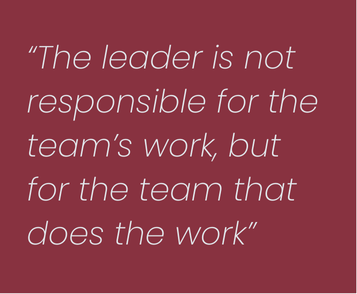
The leader is not accountable for the team’s output, but for the team itself—the people doing the work.
This perspective has also been expressed by Simon Sinek, who states:
“Leaders are not responsible for the results. Leaders are responsible for the people who are responsible for the results.”
The team is made up of professionals who are fully capable of organizing themselves, making decisions, and executing—often better than any external figure, including the leader.
The true value of leadership doesn’t lie in telling people what to do, but in ensuring the conditions exist for the team to do it well.
That means taking responsibility for the team across multiple dimensions:
- Their emotional well-being, by avoiding toxic or unsustainable environments.
- Their relational health, by fostering trust, respect, and open dialogue.
- Their operational clarity, by removing friction, ambiguity, or overload.
- And also their holistic development: supporting their professional, economic, technical, personal, and collective growth.
A healthy team doesn’t just work better—it learns, innovates, and stays.
In this transformation of leadership, we’re talking about a fundamental shift in how we think, act, and relate to teams.
Leadership rooted in control, obedience, and top-down supervision no longer works in environments that demand adaptability, ownership, and critical thinking.
This shift isn’t just about tone or personality—it’s about moving from control to trust, from supervision to support, from task focus to value creation. It requires letting go of outdated habits like micromanagement, rigid reporting structures, and one-way communication, and instead embracing collaboration, clarity, feedback, and shared purpose.
Conclusion
A leader of a team made up of highly skilled professionals—like the developers mentioned in a Previous Post—must be much more than a traditional “manager.”
Their role is to create an environment of trust, clarity, and autonomy where the team can take full ownership of their work, thrive collectively, and deliver value sustainably.
More than a supervisor, the leader becomes an architect of the environment, a promoter of organizational health, and a facilitator of continuous learning.
0 Comments