Traditional or Agile Management?
Why does the type of problem matter?
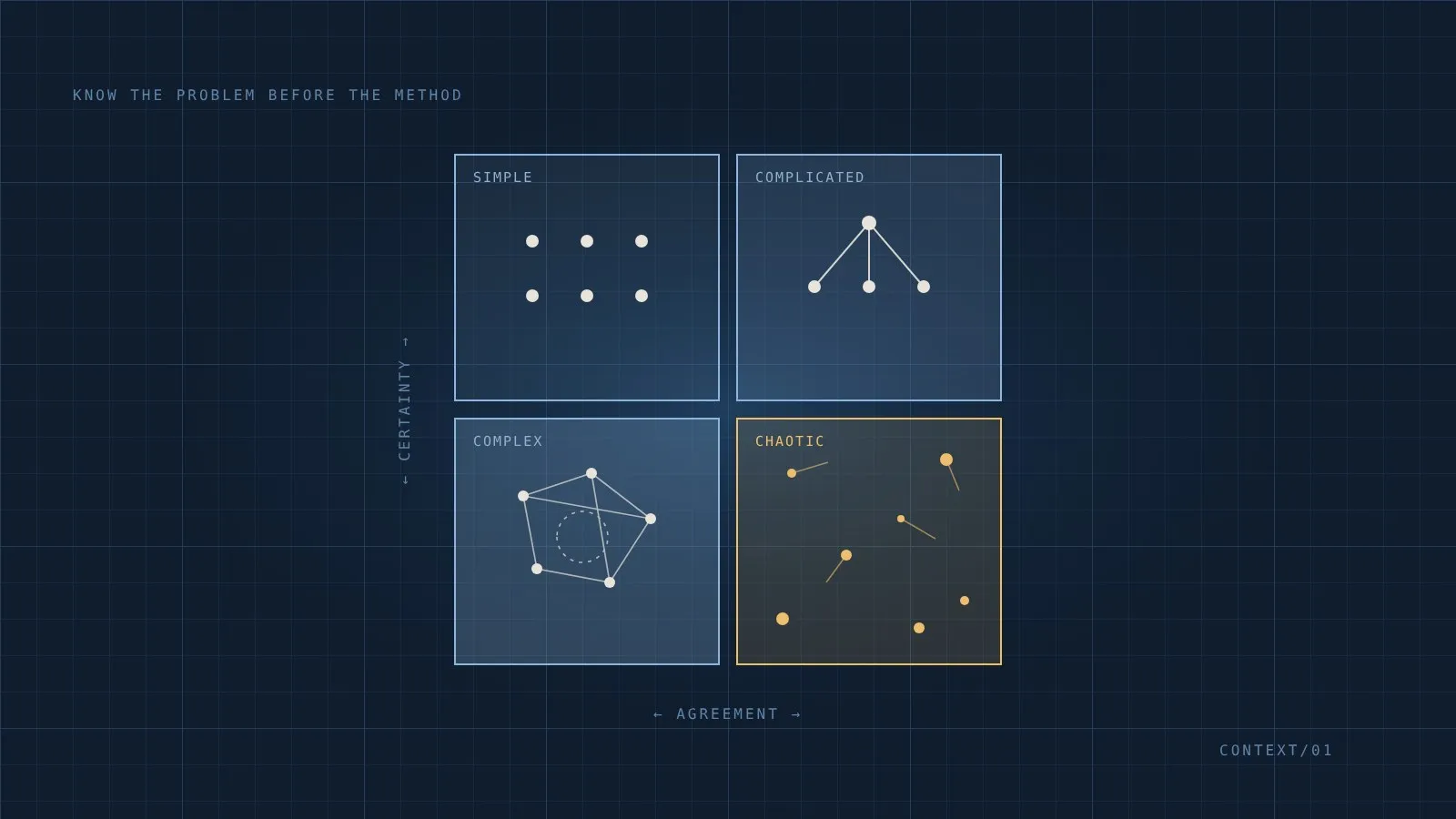
What if the real issue isn’t the method you choose, but not understanding the kind of problem you’re facing?
Before deciding whether a traditional or agile approach is best, it’s essential to understand the nature of the problem. To do this, we rely on two complementary frameworks:
- The Stacey Matrix
- The Cynefin Framework
The Stacey Matrix
The Stacey Matrix is an analytical tool developed in the 1990s by Professor Ralph D. Stacey, a specialist in organizational management and complexity theory. It emerged in response to a common problem in business environments: the tendency to always apply the same management approach without considering the nature of the issue.
This matrix has become especially relevant in contexts where innovation, digital transformation, or product development require adaptive responses rather than strictly procedural ones.
It evaluates two key dimensions:
- Certainty: How clear is the problem and its solution?
- Agreement: How much consensus exists among those involved?
By cross-referencing certainty and agreement, the matrix classifies the type of problem and suggests the most suitable approach:
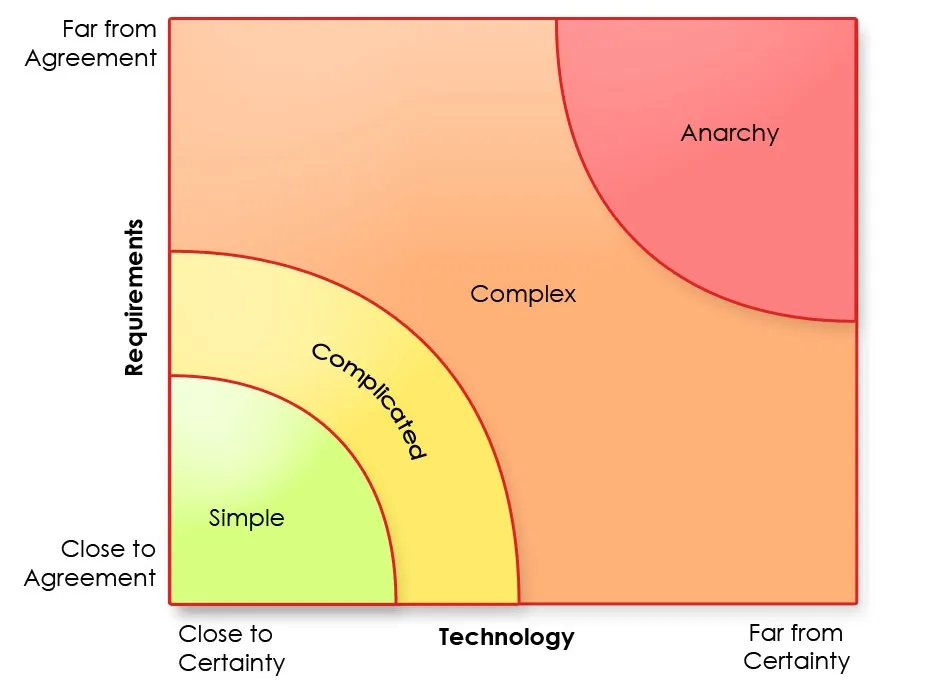
Stacey Matrix, adapted for software development (requirements and technology).
- Simple — close to agreement and certainty. Known solutions, repeatable processes. Traditional approach.
- Complicated — requires expert analysis. Detailed planning.
- Complex — many variables, unclear relationships. Short cycles, trial and error.
- Chaotic (anarchy) — far from agreement and certainty; no time for analysis. Act, contain, then reflect.
The Cynefin Framework
The Cynefin Framework was created in 1999 by Dave Snowden, a Welsh researcher in complexity theory and knowledge management.
It is a decision-making tool based on the nature of the context or problem, widely used in business management, strategy, leadership, and the resolution of complex problems. It reinforces the idea that not all problems should be approached the same way, because they depend on the nature of cause and effect.
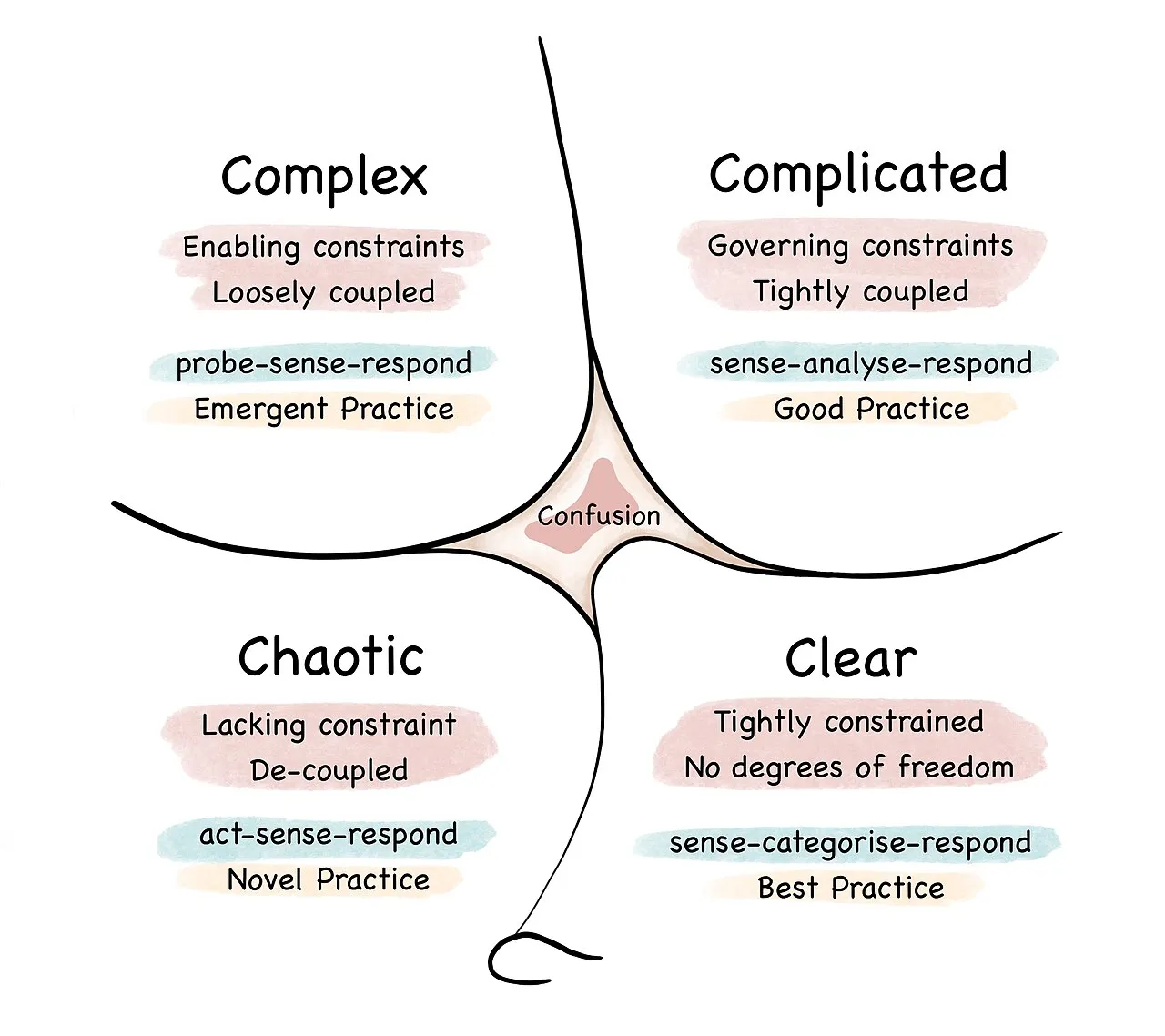
Cynefin framework. Image: The Cynefin Co (Dave Snowden).
- Clear (Simple): standard procedures, best practices.
- Complicated: expert analysis, robust planning.
- Complex: experimentation, short cycles, continuous learning.
- Chaotic: immediate action, containment, stabilization.
At the center sits confusion: not knowing which domain you’re in. The first step is to work that out.
Both frameworks help diagnose what you’re dealing with.
Conclusion
It’s not about being a fan of agile or traditional methods. It’s about understanding the problem before applying the solution.
When the environment is stable and predictable, a traditional approach may work. But in uncertain, changing environments with multiple actors and viewpoints, you need flexibility, adaptation, and short cycles.
The approach shouldn't be a dogma. It must be a conscious response to the context you're facing.